Showing posts with label painting. Show all posts

Saturday, July 9, 2011

Toronto Outdoor Art Exhibition 2011

Up front, Elizabeth Elkin. 
Fibre artist Amanda McCavour. 
I always meet the most interesting people at the Toronto Outdoor Art Exhibition.  Fewer exhibitors this year, surprising since it's the event's 50th anniversary but half of Nathan Phillips Square being fenced off for construction may have had something to do with that.  As always, though, quality at this juried show was high.
The TOAE gives out thousands of dollars in awards every year and it's fun to see when my picks align with the judges'.  My first stop is always the TOAE information booth to pick up a brochure that lists all artists by medium and maps booths.  Art Walks (Sat. and Sun. p.m.) also originate at the booth.
Grabbing my attention this year: Annyen Lam (printmaker turned paper cutter), Susan Gale (bright paintings of Toronto), Ian Mcmurrich (digital portraits with candy-coloured auras), Kevin Roach (folk art with cottage country finds), Gordon Leverton (still, Hopper-esque houses), Jorgen Lauritzen (Dali-like digital images of Toronto's lonelier outbacks).
Splashing water, seagulls, ice cream. 
It was easy to spend several hours browsing the booths, taking an espresso break inside City Hall at the Cafe by the Square, having a cone by the fountain, chatting with the artists and getting an impromptu lesson on how to work my new camera (thanks Jorgen!).
Canada's largest juried outdoor art show is a great opportunity to meet and talk with artists and buy work directly from them at reasonable prices.
The 50th annual Toronto Outdoor Art Exhibition will be up at Nathan Phillips Square, Queen and Bay, Toronto, until Sunday, July 10, 2011.
Annyen Lam's incredible paper cutting.

Jorgen Lauritzen & his Dali-esque digital media.

Ontario-inspired folk art by Kevin Roach.

Tuesday, June 14, 2011

Why I'm toasting Russia's Last Grand Duchess today

Grand Duchess Olga of Russia.

Olga's grave at North York Cemetery, Toronto.
In Toronto's North York cemetery, not far from the grave of hockey and coffee legend Tim Horton, "The Last Grand Duchess of Russia" lies beneath an Eastern Orthodox cross as white as a Russian winter.
In this city of immigrant tales, the story of Her Imperial Highness Grand Duchess Olga of Russia is one of the most fascinating--and fantastical.
Born June 14, 1882, at Peterhof Palace in St. Petersburg, Russia, Olga was the youngest daughter of Emperor Alexander III, sister of Tsar Nicholas II, aunt of the royal children--including the mysterious Anastasia--murdered by revolutionaries in 1918.
If you watch old movies [Nicholas and Alexandra (1971), Ingrid Bergman as Anastasia (1958) or Alan Rickman as Rasputin (1996)], collect Disney animated flicks (Anastasia, 1997), have danced at weddings to Boney M's Rasputin (click here to sing along with lyrics), or have bought a faux Faberge eff from the shopping network, chances are you know something of the highly romanticized Romanov dynasty.
Living with the constant threat of assassination hanging over her own Romanov head, Olga spent much of her childhood in relative isolation on a rural estate with only a few bodyguard soldiers for company.  Despite the phenomenal wealth and status she was born to, she would prefer a rural lifestyle, simple food and the company of soldiers to the end of her days.
It's hard to know where to begin in describing Olga's tumultuous life.  Bombed on a train with the rest of the family the first time she left home at age 6, Olga was only 12 when her father died and her brother became Tsar.  She didn't like public appearances, feeling like an "animal in a cage--exhibited to the public", but did her duty often standing in for her sister-in-law at functions when Alexandra was preoccupied with the health crises of her haemophiliac son.
Revolutionary attacks, wars.  Through all this--and a sham first marriage to an ambitious and homosexual Duke (which she may have agreed to simply to prevent being married off outside the country)--Olga established a hospital and trained as a nurse.  In 1903 she fell in love with an untitled commoner, military officer Nikolai Kulikovsky, and spent the next 13 years trying to get an annulment from the Duke.
Finally married to the love of her life, Olga would never again be far from Kulikovsky.  She nursed under artillery fire at a Red Cross hospital near the front lines, service for which she received the Order of St. George.
Could there have been any worse time to be pregnant and giving birth than in Russia between 1917 to 1919?  On the run and under house arrest in the Crimea after the Russian Revolution, mourning the slaughter of her brother and his family and terrified for their own lives, Olga gave birth to two sons.
The Kulikovskys ultimately spent years in exile in Olga's mother's native Denmark, some of those years under Nazi occupation.  In 1948, threatened by Stalin's regime, the Kulikovskys were accepted by Canada as agricultural immigrants and moved to a farm in Halton County, Ontario.  Olga farmed, nursed her paralyzed husband and sick maid/companion Mimka, moved to a modest home at 2130 Camilla Road, Cooksville, dealt with regular Romanov imposters and lunched with her first cousin Queen Elizabeth II and Prince Philip when they pulled into Toronto on the royal yacht.
Olga didn't last long after Kulikovsky died.  In April 1960 she was hospitalized at Toronto General Hospital, released into the care of friends, dying November 24, 1960, at their apartment above a hair salon on Gerrard Street East.  After a funeral at Christ the Saviour Church on Manning, she was buried beside Kulikovsky at North York Cemetery.  Viewed as a defender of the Orthodox faith in the face of godless communism (indeed her murdered relatives are revered as martyrs), Olga's grave gets a lot of visitors, especially on her birthday.
Why would I go?  Because I'm in awe that, despite everything that happened and everything she had to do, Olga managed over the course of her lifetime to squeeze off 2,000 paintings.  Sold to support her favorite charities and to subsidize her family's income, Olga's artwork is still widely collected and exhibited today.
I'll raise a glass of vodka to that any day of the year!
Olga's grave gets a lot of visitors esp. on her birthday.

Olga's serene landscapes belie the stress of her life.

Tuesday, May 31, 2011

Messy lives, messy art: Abstract Expressionism New York at AGO

No. 5, No. 22, 1950, Mark Rothko

Jackson Pollock (photo by Martha Holmes)
Tumultuous relationships, alcoholism, suicide.  For the Abstract Expressionists, messy lives made for messy art.  Sixty years later, their paintings still vibrate with the tragedy, passion and questing spirit that created them more than half a century ago.
Several days after attending a media preview at the Art Gallery of Ontario, I'm still thinking about the show.
Abstract Expressionist New York: Masterpieces from The Museum of Modern Art, New York, features over a hundred major works by the 20th-century artists who changed the course of art history forever.
The art of Jackson Pollock, Robert Motherwell, Mark Rothko, Willem de Kooning, Lee Krasner, Franz Kline, Arshile Gorky, Louise Bourgeois and others, defined an era (the 1950s) and was powerful enough to knock the focus of the international art world off Paris and firmly onto New York.
Highlights of the show include 13 works by Jackson Pollock including the signature Number 1A, 1948, eight of Mark Rothko's spectacular color-field works, and Willem de Kooning's snarling landmark Woman, I.
You don't need to know a lot going into the show to appreciate it.  There's a lot going on visually but clear, informative panels enlighten painlessly.  Even if you do "know a lot", there are surprises.  Who knew that the "abstract" black ovals appearing in many of Motherwell's paintings actually represent the severed bulls' testicles displayed ceremoniously at Spanish bullfights?  I didn't.
Why do these works strike such a chord with viewers sixty years later?  The anxieties we live with today--economic recession, war, fear for the planet, fear of each other--are very similar to what the Abstract Expressionists experienced.  In lives that spanned horrors like the civil war in Spain,  the Great Depression, world war, the Holocaust, Hiroshima and the Cold War, the Abstract Expressionists sought meaning in modern life.
This is what Toronto will be talking about this summer.  See the show, join the discussion!
The AGO is the sole Canadian venue to host Abstract Expressionist New York.  It will be up until September 4, 2011.

Tuesday, April 19, 2011

Fun and culture in Amsterdam

Amsterdam fun!
With canal houses resembling gingerbread cookies piped with white icing, Amsterdam charms with history.
And with more museums per square kilometer than any place else on earth, it would be easy to imagine the city as a vast open-air museum of Holland's Golden Age.  But the spirit of adventure, tolerance and freedom that built Amsterdam still lives and on a recent visit I was reminded of just how fresh and fun this city is.
View from Grachtenhuis Museum.
Flying over cobblestones on big rattling bikes, slurping cocktails under the stars on the back deck of a canal cruiser - exploring a UNESCO World Heritage Site has never been this exuberant.
Amsterdammers enjoy their city, spending much of their time outdoors on bicycles and boats, socializing in sidewalk cafes.  Visitors who alternate museum stops with a stroll through Vondel Park, a poke through an antique market, a stop for pancakes stuffed with apples or crusted with good Dutch cheese, are sifting in layers of pleasure not found on most historical or cultural itineraries.
Vintage finds.
Not that Amsterdam's museums are dry going - far from it.  If your heart has ever sunk upon being faced with acres of crucifixions and other religious scenes (and even with an art history degree, mine has), never fear here.   Art of Holland's Golden Age (think 17th century) was not commissioned by churches but by prosperous citizens.  Its subject matter - serene interiors, landscapes with windmills or comic skating scenes, portraits alive with personality and sumptuous costume - can be understood and appreciated by just about everybody at any age.
Museum shop, Van Gogh Museum.
4.5 million people come to Amsterdam each year, many to see the Rijksmuseum (the Netherlands' top tourism attraction holds several of Rembrandt's most important works including The Night Watch) and the Van Gogh Museum, to name just two of the city's top draws.
Adding to the already-rich offerings are the current multimillion-dollar refurbishment of established museums and the opening of new ones.  As part of Visit Holland's recent press group, I had the opportunity to sneak a peek at Het Grachtenhuis Museum (an elegant canal house with intriguing links to the American Revolution), the Scheepvaart (or National Maritime) Museum (seeming much like a ship itself with its light-filled, whitewashed rooms and scent of fresh-sawn oak beams), and the Amsterdam Historical Museum's fascinating new exhibition entitled Amsterdam DNA.  Another highlight was Tassenmuseum Hendrikje, a jewel-box collection of 4,000 bags and purses housed in a mansion on the Herengracht canal.
Afterwards, on my own for a few days, I explored the city on foot and by tram, revisiting old haunts and finding new favorites.  April is one of the best times in the year to visit Europe and the Netherlands.  From carpets of crocuses to babies on bikes, Holland is happiness, especially in spring.
Cafe Americain, American Hotel.
Crocuses in Vondel Park.

Tuesday, April 5, 2011

Investing in beauty: The European Fine Art Fair, Holland

TEFAF is the place to learn about art and the global art market.
If TEFAF Maastricht is the mother of all commercial art fairs, she is a gracious hostess with a salon full of fresh flowers and the best-informed minds of the international art world.
Often described as an incredible once-a-year museum in which everything is for sale, TEFAF this year hosted 260 of the world's top art and antiques dealers showing everything from classical antiquities to crave-worthy jewellery by Lalique and Cartier to masterworks by names straight out of art history textbooks: Canaletto, Breughel, Rembrandt, Renoir, Rodin, Matisse, Koons, Warhol, Bacon, to name just a few.
TEFAF's Haute Joaillerie section dazzles.
Over 150 private jets landed in Maastricht, Netherlands, between March 17 and 27.  I arrived by KLM Royal Dutch Airlines via Amsterdam as part of a North American press group invited by Visit Holland to experience the world's most important art and antiques fair firsthand.  We checked into the whimsical Hotel Mabi in Maastricht's historic heart, then it was on to the fair.
With a stint in commercial gallery sales in my past, I had some idea what to expect on the business end of things.  And with prices for many items in the multimillions, big business was definitely, quietly, afoot.  What I didn't expect was the convivial, festive ambience that makes TEFAF such a pleasure: fresh flowers by the thousands, excellent dining options, individually-designed gallery spaces providing intimate viewing areas, experts to learn from, an informed and passionate crowd.
A fairy-filled work by J.A. Fitzgerald (1823-1906).
Why attend TEFAF Maastricht if you don't have a few million Euro to spend?  The enchantment and emotion of seeing so much fragile beauty and history in one place.  To be in the company of--and learn from--people who have dedicated their working lives to art and those who choose to invest their money in the robust economy of culture and and tangible objects that are so much more than an asset.
A rare 7,000 year-old Greek idol.
Whether investing in art or just in your own pleasure, TEFAF Maastricht offers a brief window in time in which to glimpse rare and precious pieces before they pass from one private collection to another.
Celebrating its 25th anniversary next year, TEFAF Maastricht 2012 promises to be even more extraordinary.

Saturday, July 31, 2010

Beautiful downtown Pittsburgh

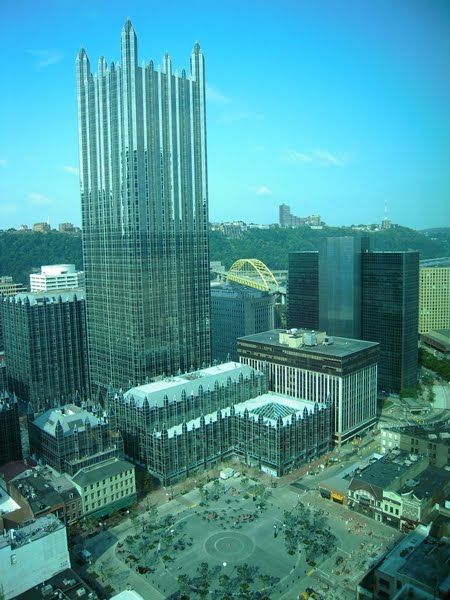
The Pittsburgh Plate Glass Building.
The Warhol.

When Visit Pittsburgh invited me to come and see the city's private and public art collections as part of a media group recently, I jumped at the chance. My expectations were skyhigh but even then they were exceeded many times over.
Yes, the Warhol. Seven storeys of work by one of the 20th century's most influential artists, including something you're not going to see anywhere else: an entire floor devoted to his films and television shows. Yes, the gorgeous Victorian Frick estate. The Carnegie, where we attended the opening of the 100th annual exhibition of the Associated Artists of Pittsburgh and had a roundtable with none other than Philip Pearlstein and got to hear firsthand of his early experiences (which included being a roommate of fellow Pittsburgher Andy Warhol for awhile) in the New York art scene.
Even more impressive than these institutions, however, was the city itself: clean and green, its interesting mix of old and new architecture (I snapped the cathedral-like Pittsburgh Plate Glass building from the 22nd floor of the Fairmont Pittsburgh) enlivened by sculpture installed just about everywhere. The city has made a definite commitment to the arts and it shows...beautifully.
A special perk to being part of the media group was that we were welcomed into several private homes to see their personal art collections; thanks so much to Damian Soffer, the Fishers, Hillmans and Hornells. Pittsburghers on the whole struck me as friendly and community-minded, perhaps not surprising since they live in Mr. Rogers' neighborhood!
Our five-day art tour ended in the Laurel Highlands where we visited the Westmoreland Museum of American Art and two masterworks by architect Frank Lloyd Wright: Fallingwater and Kentuck Knob. I really have to rate Fallingwater as a highlight of my travelling career. Simply stunning.
As was Pittsburgh. I can't wait to go back.